When researching roofing shingles, homeowners often discover that there are several major manufacturers competing for their attention.
Two brands that frequently appear during the decision-making process are Atlas Roofing and CertainTeed.
Both companies manufacture architectural shingles, premium roofing products, and complete roofing systems designed to protect homes for decades.
Because both brands are well-established in the roofing industry, homeowners often ask:
“Which one is better?”
The answer depends on what you’re looking for.
Some homeowners prioritize warranty coverage. Others care most about impact resistance, algae protection, appearance, or long-term durability.
In this article, we’ll compare Atlas and CertainTeed across several key categories to help you determine which roofing system may be the best fit for your home.
Quick Answer
Atlas and CertainTeed both manufacture high-quality asphalt roofing systems. Atlas is known for features such as Scotchgard™ algae protection and strong impact-resistant product options, while CertainTeed is known for its premium architectural shingles, extensive product lineup, and reputation for durability. Neither manufacturer is universally better. The best choice depends on your goals, budget, aesthetic preferences, and roofing priorities.
Table of Contents
Who Are Atlas and CertainTeed?
Before comparing individual shingles, it helps to understand the two manufacturers behind them.
Atlas Roofing
Atlas Roofing manufactures residential and commercial roofing products throughout North America. For homeowners, the company is probably best known for its architectural shingles, impact-resistant options, and algae protection technology.
One feature that separates many Atlas shingles is the use of 3M™ Scotchgard™ Protector, which is designed to help prevent the black streaks caused by algae growth. That can be especially relevant for homeowners in Georgia and South Carolina, where heat and humidity create favorable conditions for algae.
Atlas also offers impact-resistant shingles and complete roofing systems that include shingles, underlayment, ventilation, and other components designed to work together.
CertainTeed
CertainTeed has been manufacturing building materials for more than a century and has become one of the most recognized names in residential roofing.
One of CertainTeed’s biggest strengths is the size of its product lineup. The company offers everything from traditional architectural shingles to designer and luxury products that can give a roof a more distinctive appearance.
CertainTeed also manufactures many of the accessories used throughout a roofing system, including underlayment, ventilation products, starter shingles, and ridge caps.
If you have received several roofing estimates, there is a good chance you may see either Atlas or CertainTeed listed as an option.
Which Brand Is More Recognized?
CertainTeed generally has greater national brand recognition because of its long history and large presence throughout the building materials industry.
Atlas also has a strong contractor network and national presence, but CertainTeed is likely to be the more familiar name for many homeowners.
That does not necessarily mean CertainTeed makes a better roof.
Brand recognition can give homeowners confidence in a manufacturer, but the name on the shingle is only one part of the roofing system. The specific product, warranty, installation process, and contractor installing it all matter when comparing your options.
Which Is Better for Algae Resistance?
If you live in the CSRA, algae protection is worth paying attention to.
Georgia and South Carolina’s warm, humid climate can contribute to algae growth on asphalt shingles. Over time, this can create the dark streaks you sometimes see running down roofs.
Atlas has made algae resistance a major feature of many of its shingles through 3M™ Scotchgard™ Protector. The technology uses copper-containing granules designed to help prevent algae from creating those black streaks.
CertainTeed also offers algae-resistant technology on many of its shingles, although the specific protection and warranty can depend on the product line being installed.
For homeowners, this is where comparing “Atlas vs. CertainTeed” becomes a little too broad.
You really want to know which Atlas shingle and which CertainTeed shingle your contractor is proposing. Two products from the same manufacturer can have different features, warranties, and levels of algae protection.
If your home has experienced algae staining before, or if surrounding homes have noticeable black streaks, ask your contractor exactly what algae protection comes with the shingle included in your estimate.
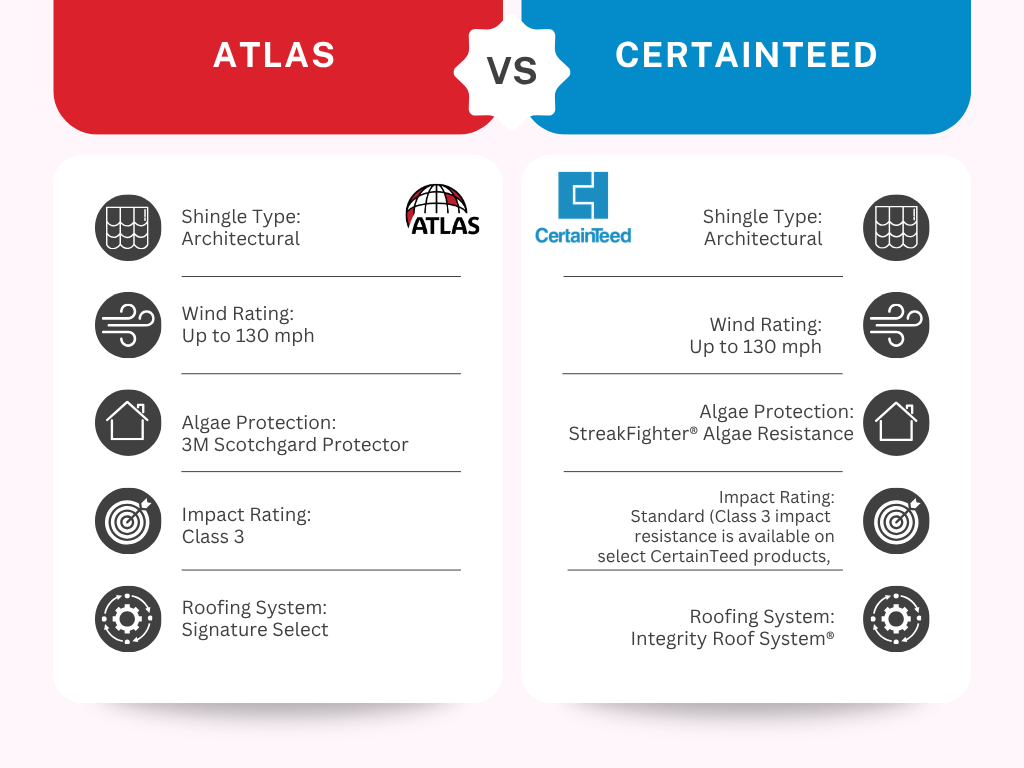
Atlas vs.CertainTeed at a Glance
How Do Atlas and CertainTeed Compare for Impact Resistance?
Impact-resistant shingles are built to better withstand damage from hail and other debris.
Atlas offers Class 4 impact-resistant products such as StormMaster® Shake and StormMaster® Slate. Class 4 is the highest rating under the UL 2218 impact-resistance testing standard commonly used for asphalt roofing products.
CertainTeed also offers impact-resistant shingles within portions of its roofing lineup.
For most homeowners in the CSRA, however, choosing an impact-resistant shingle should come down to more than simply finding the highest rating.
You should consider the additional cost, the weather risks around your home, the warranty, and whether your insurance company offers any benefits for installing an impact-resistant roofing product.
Both manufacturers give homeowners options if additional impact protection is a priority.
How Do Atlas and CertainTeed Warranties Compare?
Roofing warranties can quickly become confusing because the warranty advertised on a shingle package is not always the same as the coverage you receive with your completed roof.
Both Atlas and CertainTeed offer limited lifetime warranties along with enhanced warranty options when qualifying products and roofing system components are installed.
The actual coverage can depend on the shingle you choose, the accessories included in the roofing system, the contractor installing it, and whether the project meets the manufacturer’s requirements.
This is why we recommend comparing the actual warranties included in your roofing estimates rather than seeing “limited lifetime warranty” and assuming two proposals provide the same protection.
Ask what is covered, how long the strongest portion of the coverage lasts, whether workmanship is included, and what requirements must be met to maintain the warranty.
A longer warranty on paper does not automatically make it better if the coverage itself is limited.
Which Brand Offers More Colors and Styles?
CertainTeed has an advantage if having a large selection of styles and premium designs is one of your biggest priorities.
Its roofing lineup includes the popular Landmark® series along with designer, luxury, and specialty shingles intended to create different architectural looks.
Atlas also offers a variety of architectural, designer, and premium shingles with multiple color choices. For most homeowners looking for a traditional architectural shingle, Atlas provides plenty of options.
The difference becomes more noticeable when you start looking for a very specific premium appearance.
If you are trying to match a certain architectural style or want your roof to become a larger part of your home’s exterior design, CertainTeed’s broader lineup may give you more choices.
If you already know you want a traditional architectural roof and find an Atlas color you like, that larger CertainTeed catalog may not make much difference to your decision.
.
What About Wind Performance?
Both Atlas and CertainTeed manufacture roofing products designed for high-wind conditions when installed according to manufacturer specifications.
The exact wind warranty and requirements depend on the shingle and roofing system being installed.
This is another area where installation matters.
A shingle can have an impressive wind rating, but that rating assumes the roof was installed correctly. Proper nailing, starter shingles, roof deck preparation, and other installation details all play a role in how the roof performs during severe weather.
Instead of choosing a manufacturer based only on an advertised wind number, ask your contractor what wind protection applies to the specific system being proposed and what installation requirements are necessary to receive that coverage.
Is Atlas or CertainTeed More Expensive?
There is no single price difference that applies to every Atlas and CertainTeed roof.
The final cost of your roof depends on the shingle line, roof size, pitch, number of penetrations, ventilation needs, decking condition, warranty upgrades, and overall complexity of the installation.
Atlas often competes well from a value standpoint, while some CertainTeed designer and luxury products can carry a higher material cost.
But the manufacturer is only one part of your final price.
Two contractors could quote the exact same shingle and still provide very different estimates because one includes additional ventilation, flashing replacement, upgraded underlayment, better warranties, or a more detailed installation process.
When comparing prices, make sure you are comparing the entire scope of work and not just the shingle brand at the top of the estimate.
What Matters More Than the Brand?
It is easy to spend hours researching Atlas, CertainTeed, Owens Corning, and other shingle manufacturers while overlooking something that may matter even more: who installs the roof.
Even a high-quality roofing product can fail if it is installed incorrectly.
Improper flashing can lead to leaks. Poor attic ventilation can contribute to excessive heat and moisture. Incorrect nailing can affect shingle performance. Installation mistakes may even affect your ability to receive certain warranty coverage.
That is why choosing between Atlas and CertainTeed should only be one part of your decision.
Look at the contractor’s reputation, installation process, proposed ventilation, warranty coverage, scope of work, and what happens if there is a problem after the roof is installed.
A properly designed and installed roofing system from either manufacturer can be a better investment than choosing your favorite shingle brand and ignoring the company putting it on your home.
So, Which Is Better: Atlas or CertainTeed?
There is no universal winner.
Atlas may make more sense if you place a high priority on algae resistance, impact-resistant options, storm-focused features, and overall value.
CertainTeed may be a better fit if you want a larger selection of designer and luxury shingles, have a very specific appearance in mind, or simply prefer the CertainTeed roofing system.
For many homeowners, either manufacturer can provide a roofing system capable of protecting a home for decades when the right products are selected and installed correctly.
The better question is not necessarily, “Which brand is better?”
It is, “Which roofing system is better for my home?”
Your budget, home’s design, warranty priorities, local weather concerns, and long-term plans should all be part of that answer.
Atlas and CertainTeed are both established roofing manufacturers with strong residential roofing products.
Atlas stands out for features such as 3M™ Scotchgard™ Protector and its impact-resistant roofing options. CertainTeed stands out for its large product catalog, premium designs, and long-standing brand recognition.
Neither one is automatically the better roof.
If you are comparing estimates from contractors who recommend different manufacturers, look beyond the logo printed on the shingle wrapper. Compare the actual shingles, roofing systems, warranties, ventilation plans, installation methods, and contractors behind those proposals.
Those details will usually tell you much more about the roof you are buying than the manufacturer name alone.
A Note About South Point Roofing
South Point Roofing installs Atlas roofing systems and is an Atlas Pro+ Platinum Select Contractor. We believe Atlas makes an excellent roofing system, but we also understand that it will not automatically be the right choice for every homeowner.
Our goal with this comparison is not to convince you that you have to choose Atlas. It is to help you understand what you are comparing so you can make the decision that makes the most sense for your home, budget, and priorities